
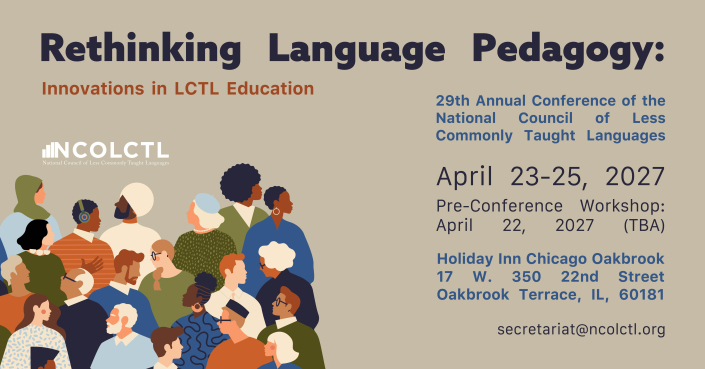
2027 NCOLCTL Annual Conference Call for Proposals
"Rethinking Language Pedagogy: Innovations in LCTL Education"
29th Annual Conference | April 23–25, 2027
Pre-Conference Workshop: April 22, 2027 (TBA)
Location: The Holiday Inn Chicago Oakbrook, IL
Pre-Conference Workshop: April 22, 2027 (TBA)
Location: The Holiday Inn Chicago Oakbrook, IL
The National Council of Less Commonly Taught Languages (NCOLCTL) invites researchers, educators, practitioners, program administrators, and curriculum developers to submit proposals for its 29th Annual Conference, to be held at The Holiday Inn Chicago Oakbrook, IL, from April 23-25, 2027, with a Pre-Conference Workshop on April 22, 2027 (TBA).
Language education is undergoing significant shifts: evolving student demographics and expectations, rapid advances in artificial intelligence, updated frameworks for proficiency and intercultural learning, and changing institutional priorities regarding enrollment and program sustainability. These developments are particularly vital for Less Commonly Taught Languages (LCTLs), where educators and programs have long responded creatively to limited resources in rapidly changing institutional contexts.
Under the theme "Rethinking Language Pedagogy: Innovations in LCTL Education," the 2027 NCOLCTL Conference provides a collaborative forum to examine how our field can meet these challenges and seize new opportunities. We welcome research on classroom-based practices, innovative pedagogical approaches, curriculum development initiatives, and collaborative projects that reconsider established approaches to language teaching and learning.
We particularly encourage proposals that examine what problems or needs prompted the innovation, how it changes the learning experience, what evidence informs its implementation, and what other LCTL educators and programs can learn from it. Although presentations may focus on a particular language, proposals should, whenever possible, identify implications or insights that can inform the broader LCTL community.
Areas of Interest
Proposals may address, but are not limited to, the following areas:
- Innovative Approaches to Language Pedagogy: Task, project, and proficiency-oriented instruction; Experiential and community-engaged language learning; Content-based and interdisciplinary language instruction.
- Artificial Intelligence, Technology, and Digital Learning: Generative AI and its implications for language teaching and learning; Designing meaningful learning and assessment in an AI-rich environment; Ethical and responsible uses of emerging technologies.
- Curriculum and Materials Development: Curricula design around proficiency and communicative outcomes; Open resources and collaborative materials development; Materials for languages with limited commercially available resources.
- Assessment and Evidence of Learning: Performance and proficiency-based assessment; Rethinking assessment in the context of generative AI.
- Learner Diversity, Access, and Belonging: Heritage and community language learners; Mixed-proficiency and mixed-background classrooms; Inclusive and accessible language pedagogy; Universal Design for Learning and accessibility.
- Program Innovation, Sustainability, and Growth: Increasing enrollment and retention in LCTL programs; Recruiting and supporting new populations of learners; Responding to institutional change and resource constraints.
- Language Learning Beyond the Classroom: Community-based and service learning; Internships and professional language use; Connecting classroom learning with professional, civic, and personal contexts.
- Research in LCTL Education: Classroom-based research and action research; Studies of learner engagement, motivation, identity, and persistence; Research methodologies appropriate for small LCTL learner populations.
Guiding Questions for Inquiry
The conference therefore invites participants to consider questions such as:
- What should effective LCTL language teaching and learning look like today?
- Which traditional practices remain valuable, and which need to be reconsidered?
- How are changing technologies reshaping what happens inside and outside the classroom?
- How can LCTL programs design learning experiences that today's students find engaging and relevant?
- How can we create stronger connections among language proficiency, intercultural learning, communities, and students' personal and academic/professional goals?
- What can LCTL educators learn from one another across languages, institutions, and educational contexts?
Presentation Formats
You must submit to one of the following formats:
Individual Paper
Time: 25 minutes (20 minutes presentation + 5 minutes questions and discussion)
A paper should focus clearly on issues related to the main conference theme. Papers may be based on original research or practical experience.
Colloquium
Time: 1 hour and 30 minutes (typically 3–4 presenters/discussants, minimum 3 presenters)
Colloquium organizers are to address topics that will foster dialogue among attendees and address the conference theme. Preference will be given to colloquia that cut across different languages or language groups.
Poster Presentation
Time: 60 minutes
A poster session may focus on completed work or work in progress related to the teaching and/or learning of less commonly taught languages. They may be in either traditional poster format or demonstrations of instructional/information technology.
Technology Note: For all presentations, if you need any technology tool beyond a projector and a screen, please bring your own technology tool. The conference will only provide a projector and a screen for all presentations.
Important Timeline
- Deadline for submission: December 4th, 2026
- Notification of acceptance: December 18th, 2026
- Deadline for Registration (for presenters): January 8th, 2027
Electronic Submission Guidelines
Important Membership Requirement: Access to the abstract submission portal is restricted to active, paid NCOLCTL members. If you are not currently a member or need to renew an expired membership, please visit our NCOLCTL Membership Plans Page to complete your registration prior to submitting your proposal.
Proposals should be electronically submitted through the 2027 NCOLCTL Conference Call for Proposals website:
- If you DO have an account on this site, please LOG IN HERE using your account information to submit your proposal.
- If you DO NOT yet have an account, please CREATE AN ACCOUNT HERE and then proceed to log in and submit your proposal.
Please complete the prompted steps to submit the proposal, including:
- A 50-word abstract
- One half-page long proposal (1000 words max)
This electronic format is the only way in which Proposals/Abstracts may be submitted for this conference.
Important Note to Presenters: All presenters will be required to pre-register and pre-pay for the conference to maintain a slot in the program. Deadline for Registration (for presenters): January 8th, 2027. Details about registration will be posted on the 2027 NCOLCTL Conference website.
Contact Information
If you have any questions regarding proposal submission, please contact the NCOLCTL Secretariat at:
Email: secretariat@ncolctl.org
Phone: 1-812-964-1930
 English